As a PhD student in the Rogers' Lab, Matthew studied the chemical ecology of spotted-wing drosophila (Drosophila suzukii) and whether aversive odorants could be used to protect fruit crops in an integrated pest management setting. Matthew’s love for plants and growing food began as a child helping in his parents’ garden. Since then, he has continued to learn about horticulture, entomology, botany, and ecology at Gustavus Adolphus College in St. Peter, MN where he graduated with a B.A. degree in biology in 2016. Afterwards, he worked as a research technician for The Nature Conservancy, Ruth Shaw’s research group, and the Cariveau Native Bee Lab at the University of Minnesota. In 2017, he began an MS in Applied Plant Science at the University of Minnesota where he studied organic chemical and cultural controls for the invasive insect pest spotted-wing drosophila.
Research
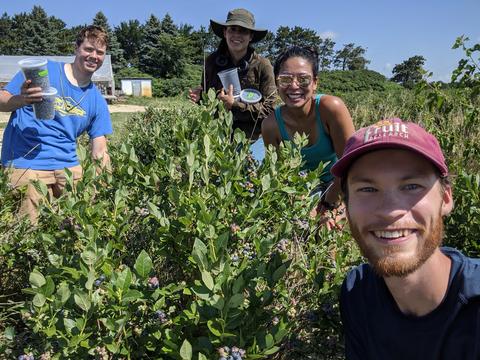
We studied the field implementation of botanical repellents for organic management of spotted-wing drosophila (Drosophila suzukii) in small fruit. SWD is a nonnative insect pest of a wide variety of small and soft fruit, including raspberries, strawberries, blueberries, and wild growing fruit. SWD larvae feed on the inside of the fruit, which causes the fruit to quickly become soft, rotten, and unmarketable. SWD is known to locate hosts via visual and olfactory cues, suggesting that plant VOCs could mask the scent of SWD host fruit, while also decreasing the use of broad spectrum insecticides which negatively impact the environment, human health, pollinators and other beneficial insects. We hypothesize that growers could artificially apply VOCs on or around small fruit crops as a natural deterrent for SWD without harming beneficial insects or pollinators. The objectives of this proposed project were to assess the efficacy of botanical VOCs and fragrant companion plants on SWD infestation in blueberry, raspberry, and strawberry crops. The results of the proposed project will guide future research and result in recommendations for both organic and conventional growers for sustainable management of SWD.
Awards/Honors
